MoneyPeace Philosophy

Summer, Swifties and Spiders

One morning last week, I was up extra early and pouring water into my tea kettle in the kitchen. I looked up and on the other side of the window was a huge spider in action building their web.

As it was the wee hours of the morning, all was quiet. I paused while my water boiled and watched the beauty of the natural world. This process is mesmerizing. 

The intricacy of web was reflected in the ideal body of the spider designed for this task. The consistent pace of their movements. And the precision, yet simplicity that flowed with this process. 

I watched a good five minutes straight and then another ten minutes off and on as I made my tea - treasuring the moment intertwined with nature.

With such a close view, I saw the spider stop part way through the process. A pause? A rest? Some of both and the time change the silk coming from their body: Now was the time to add the sticky silk.  They were not hurried, as they made the switch from the strong silk building the frame to the thread designed for catching.

My only disappointment was that I did not see how they closed it off- that happened much quicker then I thought as they left a big opening in the middle. I did find a video which includes the making of a web for you and for me to watch the final step.  Beautiful Spider Web Build Time-lapse | BBC Earth

What does this have to do with your money? I find that the spider’s approach may lead to some examples to help us.  

At this time of what seems a whirling world, slowing down needs to be strategic. And it is necessary. Maybe all we can do is appreciate the basic, simple parts of life.  

Take one of nature’s tips:

1. Apply a consistent pattern to how you manage your money. 

What day do you pay bills? Attend to planning for the month? Are you consistent with saving each month? Do you use one credit card for subscriptions? Creating a system and sticking to it will make you happier and peaceful around the ups and downs of money life.

2. Can you simplify the web of your financial life by choosing one spending category and using cash for it. 

For example, use cash only for the month for groceries. The actual tangible dollar bills give you a sense of what you are spending and keep you connected to your money. Plus, there is no credit card bill to pay later or entry to confirm from your debit card.  

3. Plan a time for organizing your finances.

We are halfway through the year. Like a spider who pauses to take in their handiwork part way through, you too must take the time to connect with this important facet of your life. Rather than wait until the year end, what can you do today to review and smooth out your money life as you move into the second half of the year. 

4. Set time aside to review your credit cards. 

Many people look at their credit card bill when they pay it. However, the details may help you make changes. Or at least become more aware of your spending. The monthly subscriptions may all be things you use. Or the charges may simply be for services you use once and do not need now. Take a look and the time to cancel subscriptions you no longer use.

5. Create an annual review of your asset allocation of all your investments. 

As we get older, therefore closer to retirement and living off our retirement investments, we want to be more conservative with our investments. Our safety account and maintaining cash is still important part of our plan. We need to look at them separately. Like the spider with two different types of silk. You have two different pools of money for different purposes. Investments are not designed for the expenses you face in the next year. You need cash for that reason.

6. Get into the details that often go overlooked:

  • Obtain different bids for your home and car insurance. One thing for sure, insurance premiums are increasing but competitors have different plans and varying costs. You may save money but take the time to see what the premium costs are from another provider.

  • Understand your employer plans. Knowing how much you can contribute to your retirement plan and being reminded of your other benefits helps you take the maximum available to you.

  • Look at your health insurance. When you know the deductible your plan has, be prepared rather than be surprised with a medical bill. Put that amount in cash to have available if and when needed.

These are six tasks that make a strong and lasting financial home. You do not have to do them all at once. Consider taking on one each month until the end of the year. Like the spider’s intent determination to build a web to catch their food, you need to pay attention to the details to create a sustainable financial future for your life.

Weaving nature and your finances creates MoneyPeace.
Don't Be Caught Off Guard, Financially or Otherwise. I Was!

Don't Be Caught Off Guard, Financially or Otherwise. I Was!

True Confessions

In my desire to inform you of the multitude of ways you may be solicited criminally, I am sharing some current scams that have come across my computer screen. Yes, like you, I have been approached before by fraudulent operators. Here is how:

Motor Vehicle Violations:

Typically send to a cell phone number and occasionally an email address. I knew I had not been stopped recently for speeding. And I know my cell phone number is not used as my number with the Vermont DMV, so I felt smug in deleting it and seeing through the scam.

Other scam texts are for toll infringement or reupping your toll transformer, like EZ Pass. They always provide a link for ease of taking your money. Do not do it. Wait for the snail mail that probably will never come.

Social Security or Fraud:

Attention CHRISTINE MORIARTY,

This notice is to inform you that your Social Security benefits have been suspended.

To resolve this matter and restore your status, please contact the SSA using one of the phone numbers listed in the attached PDF.

Sincerely,

SSA Support Team

Social Security Administration

They have my personal email address and home address so one may find this convincing. However, the email address is bogus. Definitely not a Social Security Administration email address.

Had I been in doubt, I would have called a verified phone number from the Social Security website, SSA.gov. If Social Security was my only source of income, I may have panicked and clicked quickly.

Random Mindless Email and Social Media Scrolling Is Dangerous:

Late night scanning email and social media used to be an effective way to disconnect from reality and recover after a long day. No more. You are relaxed, perhaps move quickly and are too tired to recognize the delinquent email. My local email provider sent me an email on the Saturday afternoon of a long weekend last year. They are always responsive and proactive which is why I stick with them. On first glance, this seemed reasonable. The email requested I change my password as they believed that my information had been compromised. A few clicks and keystrokes later and I was done.

Then, I walked away from my phone to get ready for bed. But before I finished brushing my teeth, I was questioning myself. I went to check the return email. A fraud. I was caught. I checked the legitimate website in a panic. Called their 800# and seemed only to get “Call during working hours.”  Finally, I tried a third time and clicked through different options and got a live human. The lovely man helped me change my password and notified the company this email was going around.

The next workday morning I got a call from my internet provider asking if everything got settled. I thanked them. No such fraudulent emails from them since, but there have been others.

The First Google Number May Be A Fraud:

Whether you search Google, Safari or through another searching tool, you can find almost any number you want. The ease of finding the right number…unless it is not. The first number that pops up may not be legitimate. I know.

In the midst of a timely technology issue, I searched for my computer providers number. And dialed right away. I was under stress and needed help. They offered me help right away for annual service package which I paid for immediately. They helped me. And only later did I realize that the company had nothing to do with the legitimate maker of my computer. An expensive lesson.

The other big phone search scam area is travel. Stranded? Or under travel stress? That is just when the first number may provide answers and cost money. But may not be the legitimate company you are trying to reach. This has not happened to me but I have heard it from others.

The Famous Authors That Weren’t:

My writing gene is strong and I love to create. I dream of having a book published by a large publishing company. I take writing workshops, participate in two writing groups, and create connections in the writing world.

In February, I did not find it strange that a well-known writer had written to me as we had met twice. Surprising? Yes. Crazy? No. He promised to send me a gift to mark his milestone birthday. And then began an email correspondence, offering to help with publication. He wanted to share my work with his literary agent. I was pumped and we kept in touch for a few months.

Then, three weeks ago I got contacted by another author who wanted to lead a financial workshop with me. Hmm, I thought. I do not know this gentleman at all. I had participated in a virtual workshop and sent an email but never met him. However, I knew a professional friend who always worked with him. When I shared it with her, she thought it was legitimate, though probably written by his marketing team.

After an email or two back and forth, he mentioned Visa gift cards and Xbox cards. I knew it was a scam and forwarded it to my friend. I wanted her to tell the author and his team directly.

Meanwhile, back to the first author. He was sharing some personal information I could not verify online. He sent an edited piece of mine that seemed to have a flavor of AI. I never got his promised “birthday gift.” The pieces clicked in place. To finalize what I already knew, I asked for his snail mail address and video call. That response ended my belief. But three months of writing emails to an Artificial Intelligence (AI) bot feels a bit foolish.


The upside of this author fiasco? I have two polished book proposals going out to agents. I figure I got motivated to fine tune what I already had.

Yes, there are other companies that make disconnecting your information from them difficult. When you want to cancel a subscription where they have your credit card information, there are so many hoops to jump in and around. I do not like those at all. But the company themselves are not a true scam. Their product may even be good. They are trying to save their income to the detriment of time, energy, and focus.

Today’s world is full of frauds, financial and otherwise. The danger does lie in phone calls but increasingly with the internet. Artificial intelligence is fueling the scamming options and makes them very convincing. There is a lot on the internet about you. With AI being used for good and bad purposes, you need to stay on your toes.

Here is my new motto: Read carefully, access when awake and thinking clearly, when in doubt ask someone, and most of all, be cautious. Verify. Verify. Verify.

Take care of yourself out there. Money and personal risks come in all forms.

And if you are like me, you have also gotten caught off guard. Please feel free to share, with me and with others. The more we all talk about what is going on out there, the better prepared we will all be.

Finding Your Financial Way: First Bank Account

First Communion. Memories of this event are powerful for any young Irish Catholic child. First Communion was a BIG deal. The nuns at school prepared us for months. And the excitement across the classroom was evident. The planning at home was exciting.

For me, the white dress meant very little as it was a hand-me-down that barely fit and under other circumstances would have been deemed too short. Only the head piece of pearls caught my attention. This gem ridden adornment was part of my Mom’s wedding garb, and the shine caught even this tomboy’s interest.

My memory of this day is vague and rests in photographs. However, after the day is what I remember. That I could count so high! My pile of First Communion cards landed with two dollars here, a fiver there, or a ten-dollar bill on rare occasion. I knew the money would sit until my thank you notes were in the mail. My Mom insisted on hand written thank you cards.

On Sunday, the day after my big day, I was young enough to report to my Dad how much money I had! What I thought I was going to do with $80 is beyond me. That kind of money in 1968 was a fortune to a child. My piggy bank may not have even been able to hold it. I do know I had stars in my eyes, understanding I was holding more money than ever in my life.

Dad said one simple thing to me that changed my life.….

“I will give you twenty dollars to make it a hundred if you put it in the bank.”

I was quick to accept the offer. And pretty speedy to write those thank yous. My first financial deal was sealed.

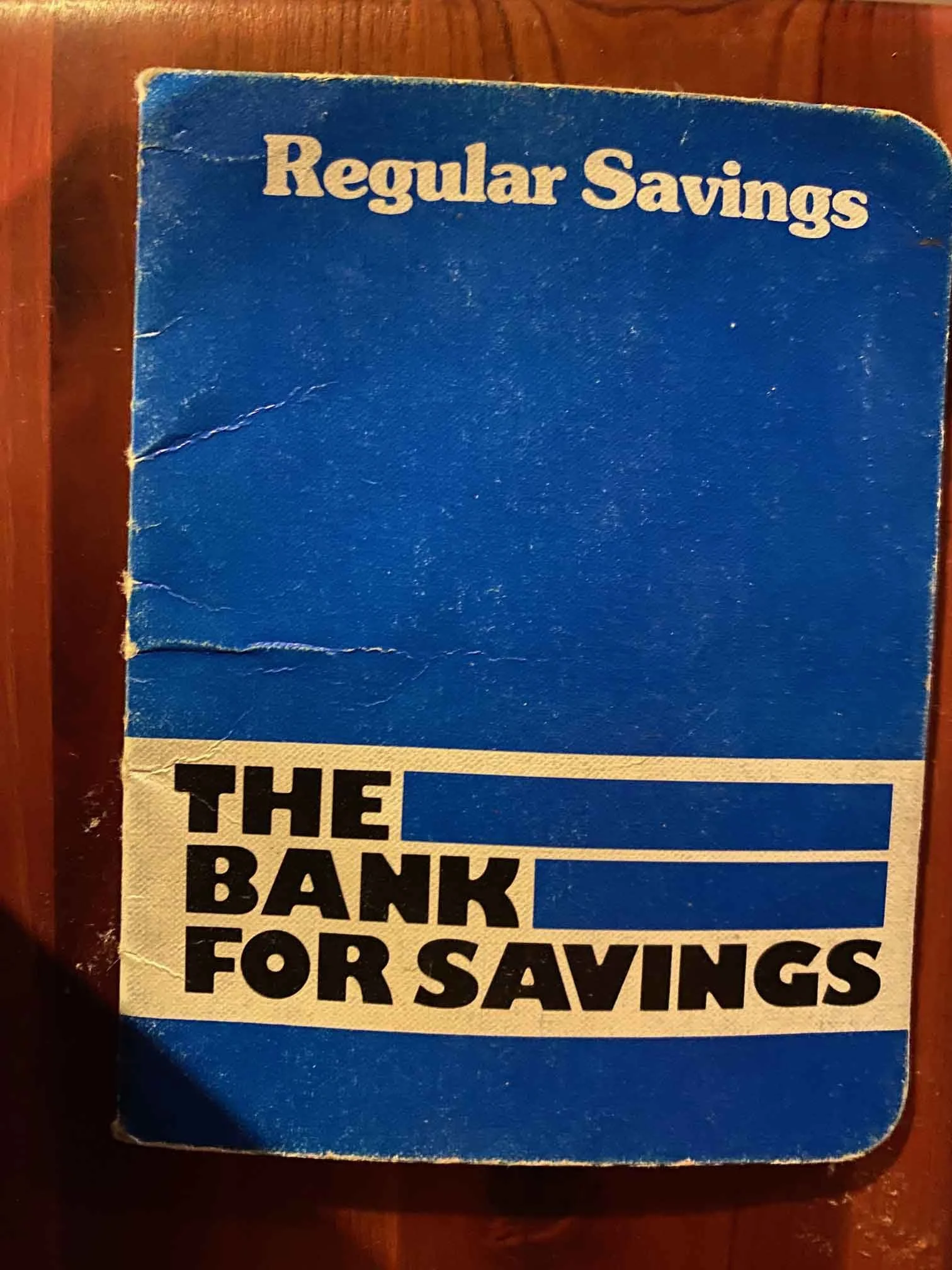
bank book

I saved my last bank book.

First Communion photo unavailable

Dad was not the one to take me to the bank. Probably my Mom or older sister walked me to the end of our street and across Main Street to the local branch office. I had been to this small bank before accompanying family – all who were older than me. Various family friends worked there over the years, so it was not an intimidating place.

That $80 would be worth $765 today – no wonder I had no plans for buying something. That is way more than I can imagine. And the $100 that opened my bank account? That would be worth close to a thousand dollars! https://www.usinflationcalculator.com/

Today, my original account is closed, though I can still rattle off the number. The bank is gone, merged with a bigger bank. I have the bank book with a box of mementos.

My Dad made a sound investment on that Sunday in 1968. He passed away eighteen years ago. Yet, that memory and the lesson ingrained in me has lasted a lifetime. Savings is good. Thinking ahead is great. And even a seven-year-old can have grown up things like a bank account. I also learned round numbers are fun to aspire to. Plus, watching it grow with my babysitting money, and interest taught me the power of compounding.

Having a savings account? That lesson is timeless and priceless.

Everyday is a Good Day

Everyday is a Good Day

Financial literacy comes in many forms at many ages. Being financially literate is not a “one and done.” And it is not all about the stock market.  It is about life. Your life and how you manage the details to build the best life possible.

Understand you first. Why? Because I do not want you to “do money” my way. I want you to do it your way. First understand your values, align your priorities. Reflect on what is important to you. Then, take appropriate action based on your needs, wants and goals. MoneyPeace will follow.

“Just the facts” as detective Joe Friday is remembered saying on Dragnet. In this case, know the facts around money. There are basic rules of investing, saving and spending to make a more stable financial life. And as I learned by over thirty years in this career, there is always more to learn. The laws change, new products emerge, and the financial world has many iterations and cycles. Your knowledge needs to keep evolving too.

For this month, become more financially literate. Explore one of these suggestions:

1. Caring for Parents' Money?

Or need to learn more about your money and how to be better prepared for aging and in case illness strikes? Check out My Mother’s Money by Beth Pinsker. She is a financial journalist who had a crash course in managing her Mom’s money. She shares what she learned, what she wishes she knew and valuable financial perspectives. Even if you are not in that position, you will learn a thing or two about why your own estate planning and understanding Medicare at retirement is crucial to quality of life.

2. Listen to a Money Podcast. 

I was on Wes Moss’ podcast and we talked about a range of topics. Check it out here  

3. Monitor your “Automatic” payments.

List who has your financial info: What apps or places you purchase from regularly have saved your private information? Think bank accounts, credit cards, debit cards. This is not only an elevated risk for you spending easily but also for more opportunities for fraudsters to interrupt your smooth financial life. This may take a bit of time now but will save you hours and hours later if your credit card is stolen or you become a victim of identity theft.

4. Delve into your emotions around money.

Create ease and education. I just learned and signed up for the Impause app. The first seven days are free. I am not always a fan of learning on the run but this is a new app with a wealth of information. And you can learn more about yourself in minutes a day. Impause is where you can learn the emotional underpinnings of your spending. The process is day to day, while acquiring information on the emotions that you face when spending. By teaching you terms and approaches, this app guides you to have new perspective on your behavior and will be informative enough to support your new behavior.  

Plus, the short quizzes at the end of each day’s exercises are fun.

Overall, a good reminder we are not alone with our money fears, issues, and emotions. And like any good app, entering your personal banking and financial information is not a requirement of use.

5. Find a Financial Planner to help you navigate the twists and turns of life.

There are many fine solid financial professionals out there. There are rules for credentials but not for influencers, influencers are easy to find. Licensed Certified Financial Planners, Registered Investment Advisors and Financial Therapists may not be so apparent on social media. However, you can check their credentials on-line and verify their professional history. They are doing their work and not always showing up on Tik Tok or YouTube. Ask your friends and family who they use, how they pay them, and what services they provide. Take the time to do the research for a better understanding of your money.

6. Watch a Video to Ponder Retirement.

This Oscar nominated short film is a different and fun perspective on retirement. The work is by a team of international filmmakers and supported by Radio Television Ireland (RTE). This Irish connection, of course, caught my attention.

Have a Financially Full and Educated Month!

If you want to hear me in person, check out my upcoming speaking events.

Looking Back on 2025:  Celebrating What Went Right

As the year ends, I believe it is essential to focus on the positive in all aspects of your life. This is the way to get “off on the right foot.” (Which reminds me I started the year off with a foot injury- now healed.) Even solid footing can be a positive part of life.

Pausing and reflecting on all the things you did right over the past twelve months. 

Each positive step has contributed to your growth and success. This look back recognizes the moments that made you proud, the challenges you overcame, and the progress you made toward your goals. 

Forget About Resolutions

Didn’t stick to your resolutions in 2025? Do not worry. You are not alone!

Recent research has shown that just 9% of Americans actually keep their resolutions throughout the year - see article.

Rather than reflect on failed New Year’s resolutions, write down a list of what you achieved! 

Take a moment to review the year. Think about a range of topics and what you may have done well throughout the year. Think Positive and Explore 2025:

Life Skills

The quality of your life covers many topics. Becoming a better and more insightful person comes from a range of areas. 

First, think about your relationships. Have you maintained and deepened connections with loved ones? Did you prioritize time together?

Then, consider what you were doing for engagement or learning. Did you pursue your favorite hobbies or have fun learning something new?

Consider your inner life. Did you deepen your spiritual life or build a community of like-minded people?

Overall, what were the best times of the year? When were you enjoying life the most? Was this in moments? Long planned adventures? Or something spontaneous? 

Chances are you are on track if you are smiling to yourself right now.

Professional Achievements

For some people, work seems “the same old, same old.” Please reconsider your year on the job. Perhaps you developed new skills or received recognition from your colleagues.

Did you take on new responsibilities and projects or otherwise demonstrate initiative and leadership? 

Did you contribute to building stronger professional relationships?

Or maybe you learned a new program or tackled something you have long wanted to implement at work.

Did you invest your time and energy in professional development, whether through courses, certifications, or simply learning from experience?

Work is where many people spend eight hours a day or more. These achievements may be overlooked as we strive in our everyday lives. Reflect on the skills you have and have developed to understand what is at your core abilities. 

Finances

This topic falls into so many mentioned in this newsletter; however, I mention it because MoneyPeace is my business. Did you find a bit of MoneyPeace this year? Perhaps you finish the year with more savings, less debt or spending plan. Incremental steps get you to where you want to go whether it is buying a home, funding retirement, or creating that dream vacation. 

Overcoming Challenges

Perhaps 2025 presented you with some challenges you did not expect but navigated with grace. If you emerged stronger for it, proving that success is often found in how we handle adversity. Relationships, physical situations, job positions along with simple tangible pieces of life from cars to homes to vacations gone awry – nothing goes perfectly. What have you learned and appreciated from this experience?

Giving Back

You found ways to contribute positively to your community, whether through volunteering, mentoring, or small acts of kindness. These efforts made a difference and added meaning to your year.

Looking Forward

As we get older, we do not get graded or medals for doing what we do every day. That was childhood or school or what promotions represent. There is so much more to life.

Celebrate what went right in 2025 – no matter what the size of the event or experience. Leading with an attitude of gratitude into 2026 will make you healthier, happier and you will enjoy life more. We all need a little sprinkle of that with a smile. Step into 2026 with confidence.

Happy New Year!

Take a Thanksgiving Moment

Thanksgiving is the simple holiday, where we take the time to be thankful. Even in this time of challenges, you can make the season what you would like it to be. The secret is to remember that the simple things in life are most important.

I have value where I live. I am happy to be home. I love where I live in Vermont and am grateful, I made the choice to live in this small town decades ago. This rural place with its fields and mountains is home.

Most of all, I am grateful for the opportunity to travel around the country and land back here. 

My gratitude extends to the opportunities I have thanks to speaking. I meet amazing people and experience different parts of the country. I have just returned from a trip to Ohio; a few pictures are included.

What I experienced on this trip was the true heartland of America, a reminder of our remarkable country. Innovation and immigration made this country. 

At the car rental return, I met an employee from Ethiopia. Going through the security checkpoint, I knew the TSA employee hailed from central America by his accent. In the United pilot’s voice, I heard the Australian accent. Despite the government shutdown, they were all working as were so many I did not meet.

In Chicago, I rode with a Filipino American Lyft driver – who gave me his book. (Thank you, Marshall!) and to the hotel housekeeping staff who I share a smile and “gracias” with each morning, I have been remembering how far we have come in our country. I am grateful for the experience of other cultures.

Wherever you fall on the perspective of immigration, I respect your opinion and experience. From my end, I am just grateful that my Dad chose to leave Ireland and land in Boston. Finding love with my Mom, herself a child of immigrants. This is not a political statement, rather a heartfelt acknowledgement of where we have come from as a country. I do not know what is ahead, but I am grateful for the past.

Gratitude also opens your world to abundance. In my professional world, I had surprises from a loan of a remote clicker which greatly enhanced my presentation to a surprise gift of a life story card deck from a lovely LifeBio professional. 

These are the momentary experiences. Often, they get lost in a world filled with traffic, emails and commitments.

I have often heard the expression "What we focus on grows." Join me in focusing on love and appreciation this month. 

Try Gratitude on for size:

  1. Take a moment this month to think of people to whom you are grateful. The first things that come to my mind are the person who taught me to tell time and my cousin who taught me how to tie my shoe! You may have in mind your first baseball coach, your favorite college professor, or first employer. 
    

  2. Be spontaneous and call or write one person who impacted your life. Let them know what their input meant to you in your life. 
    

  3. Create a Thanksgiving tale: Tell others of something you are thankful for in your life – where you live, your friends, or a recent vacation. Start a conversation about what they appreciate, maybe over the Thanksgiving dinner table. With all that food, there will be plenty of time to talk gratitude as you digest and start on dessert.


I am off to write a few notes. What are you going to do to spread the attitude of gratitude?


 Wishing you a happy and gratitude filled Thanksgiving.

Pondering a Home Purchase? Read This First

Buying a house is a major life decision, whether it is your first home or a retirement home. You should not be swayed by the real estate market, interest rates, or your parents or friends’ opinion. This consideration marks significant personal and financial milestones. Those are what make an opportune time for one to consider homeownership.

Buying a house can be a smart financial and personal move, provided you are prepared for the responsibilities and costs involved. Or if you are heading into retirement, you are ready to manage two homes financially and operationally for a time period. Homeownership works for some people but not for others. If now is not the time to make this choice or take on this commitment, then they should be your individual reasons, not a reaction.

From personal experience, I know a certain age is not always the time to buy a home. I had lived in Boston for more than five years but did not buy a home. First, I did not want to live there long-term. Second, I wanted to go to graduate school and could not imagine managing a mortgage while in school. As soon as I was ready to move to Vermont, I made the commitment. I never rented in Vermont as I knew the area and knew I wanted a home.

I also had lived through a period of increasing and decreasing values of property. Knowing the reality of real estate is critical to making a sound purchase. Taking the time to learn about properties or communities of interest is not wasting time. That is an investment in your future.

What I am hearing today is that certain people are not buying because of the interest rates. They feel they are too high. When I bought my first home, I felt I had a wonderful interest rate of 5.99%. And I did for the time period. The years previous to 1997 I had seen the rates as high as ten percent. Perhaps the recent years of historic low interests have tainted all of us. Check out the rates for yourself: Mortgage Rate History: 1970s To 2025 | Bankrate

Plus, the interest rate explanation alone is a false narrative. Very few people have the same mortgage for the life of their loan. They may move and sell the home. Homeowners refinance when the rates go down. They pay off the loan earlier than expected.

Instead, switch the story:

  • Decide to sock away more cash for the downpayment so you are paying less interest over the years of your loan.

  • Adjust your expectations. Purchase a smaller home. Buy less land or live further out from the city center. These decisions allow you to spend less on a home.

  • Shed a mortgage expense. Create a longer-term plan for savings. Know how long it will take you to build up 20% for a down payment. When you have a larger down payment, you will not have to pay private mortgage insurance (PMI), saving you a hundred to several hundred dollars a month, depending on the size of your mortgage. This insurance is for the lender in case you default, so you are losing nothing while saving money for decades to come.

Think of a home purchase, whether the first one or a retirement abode, as a stepping stone in your life, not an end point. Also, understand that real estate generally increases in value in the long-term though may not always in the short-term. That means the most important thing is to find a home you love and want to live in. It may not be perfect. You can make changes over time. You can refinance when the rates lower, which they will be someday.

Purchasing a home is a personal decision. Careful planning and consideration of the above factors can help ensure a successful transition to homeownership whether you are jumping in for the first time or looking for a community to land in retirement.

If you like this piece, I hope you'll share on your network, too.

Five Steps to Join Me in A Conscious August

Five Steps to Join Me in A Conscious August

Consciousness is what I teach whether with spending, saving or investing. What did No Buy July do for me? Reminded me to revisit and reflect on my spending periodically myself.

July was an opportunity to be more intentional about my spending or lack of it. Yes, by nature and profession I pay attention to numbers, especially cash flow. Yet, there is always room for improvement.

I often spend when I am tired – too tired to cook or exhausted from the day and just want to zone out in front of the television, meaning I reach for something that will entertain me best – often a movie or recently released series. Most of them with an upcharge.

I am a realist. In today’s world, spending is ever present. How you do it and when and why are the questions. Those deeper questions are what is important to getting one’s spending under control.

In addition, taking care of the financial details provides the clarity to get a handle on one’s finances. The month of July allowed me the time to slow down and really look at what was occurring with my spending.

You may benefit from my learnings. Here’s the specifics of what I learned and my next steps:

1. Write Wants Down:

I need to write things down that I want or perceive as needing. Delaying spending is a strategy we all can do. Then, you can prioritize and be thoughtful about your purchases. Plus, that mindful step which slows down the purchase, makes one more appreciative when the purchase arrives.  

Prioritizing is not easy, where I struggled was everyday typical things I used.

For example, are vitamins a want or need? I waited to replace some until the end of the month, considering them groceries.

And what if something broke, did I buy a new one right away? My electric kettle boiled its final water mid-month. As something I used multiple times a day, I wanted another one; however, I realized I had other options. I boiled water each day on the stove. The delay reminded me to appreciate an electric kettle. The wonderful convenience was the first thing I bought on August 1st. 

2. Review Subscriptions:

Taking the time to go online or on the phone to change or cancel subscriptions pays off. With the extra time last month, I revisited all my subscriptions. The prices have risen for many. Cancelling was easy for the ones I do not use often enough. Yet, each time I tried to cancel, I was offered a better deal. I came out saving about $12-15 dollars per subscription I decided to keep. And saving the monthly payout on the ones I cancelled.

3. Question Financial Apps:

People always tell me that their bank, phone app or financial procedure is the best way to go. Digitally makes everything easier. They do not mean you do not have to pay attention though. This month I learned, Venmo is not always perfect. I use it occasionally to pay or receive money from friends. When I went to pay for a yoga class, I noticed a request that was waiting out there from an event three years ago. Strange I thought I had never noticed before now and thought she had paid me. I did nothing until my friend texted me because she got the same on her end and was appalled she had not paid me. I told her I really thought she had but after looking through my Venmo app could not find the payment. She did some research and sure enough had a screenshot of having paid the exact amount the same month we travelled together. Lesson learned for both of us and now hopefully, you.

4. Make Minor Changes:

Minor changes add up to big ones. Not going into stores. Not using credit cards. And then avoiding the pervasive latte option. Slight changes make life better as there is more money left at the end of the month.

5. Benefits of Not Buying:

Not buying means Time for other things. If you are not scrolling Amazon, or clothing sites, nor heading out to shop, there is more time for walking, cooking, and being with loved ones. A bonus that far outweighs any other advantage of being conscious financially: time.

Always think critically about buying, signing up for a subscription or spending money. Spending needs to resonate with who we are, not be an automatic reaction.

So what am I doing for Conscious August:

1. Taking the time to write it all down. Whether I use credit cards, debit cards or cash, whether it is for business or personal, this month I will record it everything.  

2. I am also reading and sharing what others say about this money behavior we use automatically. Like Michelle Singletary who summed it up best in a recent article, “Five Financial Lies People Should Stop Telling Themselves.” 

Singletary covered a range of topics from not having an emergency fund to spending more on dining out than you really know.

Here is my favorite from her piece: 

"I manage my spending better with a credit card. Monthly statements show where money went, but research reveals that paying with plastic — credit or debit — increases how much people spend. A Federal Reserve Bank of Boston report found that consumers spend an average of $22 per transaction when paying with cash, compared with $112 when using cards."

To see the whole piece may be challenging as I am not a subscriber so sometimes I get in, sometimes I do not. Keep trying. Here is the link 

One outcome of my changing behavior in July? Watching the Seventies television show, Rhoda free on YouTube instead of the pricier Gilded Age. Spoiler alert, I am still sad that Rhoda and Joe separated. I think I am less attached to the Gilded Age characters as I did not grow up with them. That show feels like history. Rhoda feels like a friend. 

May you find more time for yourself and with friends this month and in the future, because of your conscious financial decisions. 

I will be out of the office periodically over the coming months for fun and speaking. From conferences to a friend’s wedding to speaking gigs. I am looking forward to an active fall.

No Buy July comes to MoneyPeace

No Buy July caught my eye because of the catchy rhyming phrase. I also thought “this will be a cinch.” Afterall, I'm already aware of my spending, I don't like to shop. And it's summer! My confident thoughts were misinformed. Confidence and consciousness do not always align.

Instead, No Buy July has had a deep impact on me. I have been learning even more about myself, my spending, and my choices. MoneyPeace’s principal of making conscious choices are not always aligned with my spending. Let’s call my choices “a little fuzzy sometimes.” Yes, I was still making a few not so conscious choices. I had no idea how often I stopped for coffee or a treat when I had a busy day. Using this as a reward and rest when a few minutes sitting in the car or chatting with a friend would have done the same.

Then, there is the burnt out me – stretched on the couch, looking for some intriguing show to watch. When I stumble on just the right thing, Amazon often wants to give me an upcharge. What is a few extra dollars? That is what they have trained us to think. Whether a monthly Netflix subscription, free week of HBO or limited time subscription offer flashing across the screen, this weary decision maker will usually click. However, day one of No Buy July, I caught myself before I did. Yes, I wanted to see the latest season of the HBO series, The Gilded Age, but I kept on track. (Please do not tell me what has happened.)

So I did jump in with both feet to No Buy July, but had to adjust in week one. Quickly I learned that I had to adapt one of my strict rules of no extras. I wanted to honor my commitments that I had already made. Last week, I took a friend out for their birthday lunch – it was delicious and fun. No matter that their birthday was in early June! I had promised them a birthday lunch and so I paid for something that wasn't essential or groceries.

I have found the upside to all this no buy. This past weekend I did some chores with the materials at hand. They were the projects that had gotten delayed partly because I really wasn't psyched to do them. In the midst of polishing windows, polishing my leather Blundstone boots and a bit of deep cleaning in the kitchen, I did not think about spending money at all. When I was done, the added bonus came to me: no longer were chores staring me in the face and making me weary!

I also cooked and baked this weekend because I had time. Those activities had their own benefits. I was staying off the computer and its buying temptations and ate better, too. Win, win!

There have been a few non-wins. After that lunch last week, I wandered into Sweet Charity. This delightful secondhand store always draws me in. On that day, They had candles at an incredibly discounted price and I bought four to have at home. Only when I got home and went to put them away, did I realize my slip. No one's perfect!

Whatever your motivation to try No Buy July or any other financial change, remember you have control over your money and decision making. You may want to cut your spending, stop supporting large corporations, or just become more attentive to your everyday life.

Here are some tips to get you in the swing of not buying:

  1. Can you get your family on board? Or perhaps some friends to make it more fun?

  2. Clean up some paperwork that has been set aside. Bonus if it brings in money such as medical reimbursement or expense reports.

  3. Plan an outing that is totally free. See how much fun you can have, then plan another.

  4. If staying off the computer is not for you and on-line shopping is calling, email yourself the piece of clothing or sporting equipment you really want. Then, set up a folder titled shopping or No Buy July and file it there. In August, go ahead back there and review. You will have an easy reminder if what you wanted is still important to you.

Pay attention to what you learn. This is about getting off autopilot and back in conscious decision making around your money. The world moves fast. We need the reminder that we do not have to keep up the pace. Sometimes a pause may be the most nourishing gift to give yourself.

Want to follow more about what I have been learning? Check out my videos on social media or my blog.

Have a fun month!

99 and Feeling Fine

My first major learning was on a fan bus to Rockies Baseball Stadium. Okay, the true picture was it was a Boulder City bus that went to Denver every day but this Sunday I was on my way to the game. (To cheer for the Dodgers with my husband, but on the bus, we kept a low profile.) As the bus filled at every stop, to the point that people were standing in the aisle, a family got on. There was a bit of standing room though a lovely person had her two young children get up and sit on her lap for the eldest of the clan. A smiling woman about my age said, “Oh, here is a seat for you Grandma.” I smiled. The woman’s two young children squeezed in a seat nearby. As passengers crammed up the aisle, I had the smiling woman next to me and started up a conversation. She was with her own family of four and her Dad and her Grandma heading to the game. She offered, “My grandmother is 99!”

Ninety-nine and taking the bus. Ninety-nine and a huge Rockies fan. Ninety-nine and spry as someone twenty years younger by my observation. “What is her secret?” I asked as I was truly curious. Here is what I was told:

First, she has “No Regrets.”  

Second, she believes in, “Let it Go.” 

Her granddaughter added that her grandmother is Catholic and believes in the power of confession and confessing as part of the letting go process. Then, she moves on.

This 99 year old so impressed me, as I have been telling anyone who will listen. Neither of her mottos are easy to live by. I would add she did not have an easy life based on the brief conversation with her granddaughter. She lost a son in his twenties. Then, a second child died before her when she was an adult. She carried on. 

The final secret I learned when we all got off the bus a quarter of a mile and many stairs from the stadium entrance. On the arm of her “senior citizen” son, she was keeping pace with the rest of us. Her grandson in law commented, “Wow, Grandma, you walk along great.” 

 “Why wouldn’t I? I walk every day!” So I add to the healthy and happy list until 99, walk every day and have a bit of spunk! A passion or two will help as well. 

How are you preparing for a long and healthy life? Plan your finances, yes. Planning your life is just as important.

  1. Check Your Regrets at the Door.

  2. Release and Let Go. Move On.

  3. Go For a Walk.

  4. Enjoy your Passion.

  5. Carry On.

Thank you Grandma for the lesson.

Mother Knows Best

May this find you all healthy and grounded as we ride out this unnerving time of life. I hope revisiting the suggestions below help you during this time. 

Whether you listen to the political pundits or the astrology experts and everyone in between, you may feel like Chicken Little, “The sky is falling, The Sky is Falling." The stock market is falling or rising dramatically, depending on the day. Legislation is changing. War is raging. The world is shifting in dramatic ways and there is nothing we can do about it. Or is there? 

Rather than stopping to listen to more noise in this erratic world, find out where you can make an impact for the better. That starts with and within yourself. The weather we cannot not do anything about, but we can put on a raincoat when it’s raining. Metaphorically speaking, it is raining now so what can we do?

The Stock Market: 

You cannot change what the stock market is doing. So, adding or decreasing your stock holdings will not change much. However, you can change your personal situation by rebalancing your portfolio. This simply means being sure that the risk you are taking with your combination of stock and bonds is appropriate for your needs. Another simple change applies to the new money you contribute to your 401k or other investments. (Do not stop investing.) Change the allocation to a more conservative investment than where it is being invested now. For example, if 100% of your 401k paycheck contribution is going into stock currently, you designate future contribution to be invested half into a bond fund and the other half to a stock fund, or do one-third each to cash, bonds, stocks. That would make it more conservative without missing out or having to make changes again if the stock market shifts. 

On the Political Front: 

Write your congressperson. Get involved in a campaign. Run for office. Becoming involved is critical to changing the process. Do not sit out the democratic process. 

Daily Spending:

Whether it be takeout, Amazon or on-line classes, we all developed new spending habits these past couple of years. Now is the time to reevaluate once again what fits our new world and whether some of what we needed in the recent past is no longer necessary. Even a monthly $9.00 adds up to $108.00 a year that can be saved or spent more appropriately for today. Perhaps you could cancel just one subscription? Check out this video for help

Climate Change:

Reduce, reuse, recycle. Many forget that first one...Reduce what you use. Personal impact matters. And sets a good example. If you are already doing that, find a way to educate others or just be an example in your community.

Charity:

Giving to a good cause of time and money is a powerful gift. When we give money, we are saying “we have enough to share.” We also do the same when we give our time to a cause we are passionate about. Most of all, giving feels as good as receiving and the studies prove it. Neural responses to taxation and voluntary giving reveal motives for charitable donations

Do the next right thing for you. Conscious action steps can help us move forward and decrease the Chicken Little emotional reactions. By taking conscious action, you have something positive to focus on. 

Take Care of yourself.

Time to Live Differently? Here’s 3 Ideas to Start

Time to Live Differently? Here’s 3 Ideas to Start

Gradual changes create sustainable improvements. Yet, we are in a quick fix society. Ponder the following ideas to implement long-lasting changes in your life.  

These are the ideas I have been thinking about:

1. Could you live on less?

Reduce. Reuse. Recycle. Food to clothes to housewares. Not only would this be good for the environment, your pocketbook would be in a better position as well.

The impact of you and your decision making is a way to take care of yourself beyond an economic blackout day, “no spend” January or stressing about how to save money.  

Living on less involves more thoughtful choices. Intentional spending, rather than on-line scrolling.  

Conscious consumption is not dictating what is right and wrong for you to spend on. Rather, you choose what you really want versus what is available for you to have. This lifestyle involves critical thinking. As a result, you will find yourself gifting, donating and sharing some of the things and clothes you do have.  

Think about the impact of you! Your finances will thank you if you start small today.


2. Car Planning And Options

For my CFP, I am always attending continuing education sessions. This month the tax code and changes got me thinking and learning about electric cars. That session led to reading more about new cars. 

I love cars and yet, I realize the fastest, newest and shiniest are not usually necessary for transportation. With all the car advertisements and holiday sales, this is easy to forget.

The idea of electric cars has always been appealing to me. Tax benefits made many consumers take the plunge. But now the tax perks are gone, I am still pondering.

A call to my insurance agent about something unrelated got me talking about electric cars. (I told you I liked them!) His perspective is “consider the practical aspects of owning one.” For example, check with your insurance company for what the insurance will cost. These vehicles are heavier and repairs often more expensive, leading to more costly insurance coverage. And, be sure there are charging stations where you live.  

There are other options from gas to hybrid or better yet if you are city dweller, reevaluate owning a car. A recent article on a car free community is intriguing.


3. Take Time Out

Time out from from the world is extra critical these days. Try a few with mental breaks through movies, television, or creativity. This will help you turn off the news and the phones. “Time outs” are effective for young minds and emotions. Why not adults?  

One way to do this is to keep up your creativity. I have been writing. You can feed your spirit by doing your art, whether painting, sewing or woodworking. Whatever does the trick will lower your stress and keep your positive energy flowing.

May they save you from ruminating about the state of the world temporarily as they have helped me.


Still preoccupied with the stock market gyrations?

I will write more about it in the future. For now, check out my blog from another springtime that had many reeling:

St Patrick and Riding the Wave of the Stock Market

Share the Love!

Share the Love

Roses. Chocolates. Red Hearts. Tis the season that is celebrating love.  

What if we looked beyond the cards and special dinners of Valentine’s Day? Consider the other ways to show your love. I have just the gift for you; Something lasting and meaningful.  

Here is how this CFP wants you to demonstrate your love this month:

1. Have a Well Done Estate Plan. 

What does that mean? You have created a legal plan. One that is written down and documented to cover the realities of life from illness to death. Not because you are sick or dying or some kind of pessimist but because you want your wishes followed through and desire ease of transition for those left behind. Create Peace of Mind, sign an estate plan.

2. Have Cash to Offset Stress of Life Events.

No matter who you are or where you live, life throws curve balls sometimes. Financial curve balls usually coincide with life events which are unexpected. Building a cash account just to sustain you and your loved ones during such times is loving for yourself. This money cushion is registering the reality of self-love. Knowing that whatever happens, you will not encounter added financial stress. Promote calm, have cash. 

3. Review Your Investments Every year.

Investments all too often are left to the set it and forget it approach. In our busy lives, we figure if it has been working for the past decade there is no reason to mess with a good thing. However, in that decade, our lives have changed. We need to make sure our investments are appropriately invested for our age and goals. They change and so should our investments. Rather than leave it in the professional hands alone, be sure to check in at least annually to align your investments with who you are today.

Live in the present, check-in with your investments accordingly.

Yes, the above steps are harder to do than stopping at a store. The flipside of those glossy cards is true care which inspires action. The time and energy involved focus on something long-lasting and deeper like your love.

Life changes. When you are prepared, your life can weather any movements in life or the stock market.

Time well spent is time on yourself and your financial life. The above will help you, which leads to helping your loved ones. You will be planning for your financial well-being and that of your loved one for the long-term.

Peace of mind and heart will radiate love for yourself and expand to others. The kind of demonstration of love that lasts long after the chocolates are gone.

Go ahead do the visual expressions of love. Buy the flowers. Sign a card. And make the grand gesture of loving gratitude to your loved ones.

Forget Your Financial Resolutions! Do this Instead!

Your financial consciousness will improve and continue to improve by taking care of what you have. 

Studies tell us that people quit their resolutions early in the year. A Quicken study learned that 63% of us spend money to aim to accomplish their goals for the new year. Financially, there is one step you can take to improve your financial situation and understanding. Do it this month. And then every January.  

Creating Your Net Worth for each and every December 31st will give you a sense of your personal financial situation. And it does not cost money! 

This is a one page summary of your financial life that too many people seldom consider. Having the information at your fingertips of your investments, savings, and debt at one point every year allow you to see progress. More than that, the summary will show you what you want or need to change in the coming year.

Here are the steps to make your own net worth:

  1. Decide if you are going to do it by hand, spreadsheet or a form. (I will share a form to start you off on my blog, here.)

  2. Gather your financial information. You may need passwords, connectivity or recent statements from the mail.

  3. Using the same date for the financial details as much as possible, begin to list all your assets. This includes the smallest checking or savings account, the savings bonds, retirement accounts and stock accounts. Plus include a car or home if you have them.

  4. Find your debts as of December 31st. Your car loan, credit card, personal loan and mortgage are all debts you owe to someone else or a financial institution.

  5. Total the assets. Total the debts.

  6. Subtract the debts from the assets. This is your net worth. The number may be positive or negative. For example, when I finished graduate school, I had a negative net worth despite my MBA. If that is the case for you, remind yourself it is temporary.

With this information at hand, make your financial decisions for the year.  

Thinking of taking a trip that may need to go on your credit card? Review your net worth first.

Debating about how much to put in a 401k at your new job? One look at your net worth will show where you stand for retirement and may motivate you to increase your contribution.

Looking to apply for a mortgage? Updating your net worth will prepare you for the paperwork.

A Net Worth statement raises your financial savvy about yourself. This one piece of paper will grant you more consciousness around your money than all the programs that guarantee to improve your situation for a fee. 

Once you have an understanding of your financial assets and debts, you are better informed to make all sorts of financial decisions. And you have one financial tool and system to carry forward into the rest of your financial life.

More on Resolutions:

Here are some studies on New Year’s Resolutions:

AI Shared this with me…

Research on New Year's resolutions shows that while they can be effective for some, most people don't keep them. Some factors that contribute to this include: 

  • Lack of a plan: People often make resolutions without a clear plan for how to achieve them 

  • Pressure: People may feel pressured to make resolutions, especially women and Gen Z 

  • Negative language: Resolutions framed in negative language can make it harder to stick to them 

Who makes New Year's resolutions? 

  • Young adults are most likely to make resolutions

  • There are only modest differences in who makes resolutions by race, ethnicity, gender, or partisanship

What are the most popular resolutions? 

  • Improving physical health

  • Saving more money

  • Exercising more

  • Eating healthier

  • Being happy

  • Losing weight

How can you make your resolutions more effective? Frame your resolutions in positive language, Set goals that provide direction and purpose, and Find ways to stay accountable. 

Five Steps For Reviewing the Year Gone & One For The New Year

To Know Where You Are Going, You Need to Know Where You Have Been:

5 Steps to Review the Past and A Bonus One to Move You Forward!

1. Gathering Medical Receipts

Separating the medical expenses falls into different categories. For me, medical costs include my deductible and for certain other medical reasons like eye care. Knowing that total helps me plan what I may be spending for 2025.

In your case, you may use that number to get reimbursement from a Medical Savings Account at work. Or to plan funding for your Health Savings Account for next year.

I did it this week as I can confirm I did not miss any as most appointments are fresh in my mind. Most of all, I am ready to start my taxes when that time comes. Having the totals easily available make taxes less stressful. (Notice I did not say not stressful.) And who does not need lower stress?

2. Finishing Up Business Details: Expense Reports

I sometimes pay for business expenses in cash, rather than my business debit card or credit card. I am great at keeping the receipts but not so great at reimbursing myself. This past week I sat down with all the receipts and scraps of paper. Then, I categorized and totaled and submitted them for payment to MoneyPeace. Okay, me, but you get the point. Details matter. And add up.

With the computerized systems corporations have now, your expense reports are easier; however, you still must do them. Spend an hour and see what money you have coming to you.

3. Creating a Net Worth Statement

Keeping one page of my financial assets helps me maintain understanding of where my money is and how to find it. Seems basic; however, every year when I fill in the blanks of assets and liabilities, I learn something new.

I look at my holdings and balances more closely at this time of year. I discover which investment is doing well. I learn how much I have tucked away for my goals like travel or a new vehicle or home improvements. I look closer at how I used my credit card and what bits may be lingering.

By setting aside a bit of extra time to review all sides of my financial life, I have a complete picture of what has happened during the year. Some of the information is a review and some a revelation.

4. Confirming Charitable Donations

I made a list and checked it twice. Now I know what I gave and to whom. I also know which charities I like to support that I may have missed this year.

For those who give exclusively via one credit card, you would tell me it is easy: They give you the total. I like my deeper dive because I see what matters to me, where I took action and where I may like to contribute next.

Yesterday, I took to a reputable donation center some clothes and housewares. Cleaning out a few things I did not need, feels good. Passing reusables on to others feels great! As a bonus, I got a receipt for taxes.

5. Review my Accomplishments

This past year featured several diverse highlights for me - from a train trip across Canada to a wedding in a castle to speaking for a wonderful law firm in Kansas City.

Writing continues to be one of my loves. And it is a treat when one of the pieces that get published is a personal story. Recently, I had one published complete with a picture of me from childhood in a Christmas dress. Just for fun, I share it here.

Bonus: Resolutions or Intentions

Resolutions no longer resonate with me. Since I was in my twenties, I have set an intention for each year. This is the time of year it comes to me. I give it time to unfold. Then, I aim to use that as a check point when making decisions throughout the year. 2025’s is still brewing.

Some past ones were: Healthy & Happy, Life is Good, Grateful. You get the idea.

What are you intending for 2025?

None of the above takes much time. All of it requires quiet time to yourself. Why not take an hour and take one step from the above list? See how it feels. You may just want to start on the other steps on the list.

May you have many reasons to celebrate this turning of the clock to the New Year.

Thoughts on Gratitude and Thanksgiving

Thoughts on Gratitude and Thanksgiving

Today as the world spins around us and so many events and circumstances are out of our control. We need to remember what we have to appreciate. Gratitude feeds our sense of abundance.

Maybe we have special memories of Thanksgiving or favorite foods or moments of gratitude.

Memories of favorite foods bring me smiles. One strong memory I have as a child is Nanie Sheehan cutting the turkey in our kitchen each Thanksgiving. She would threaten anyone who came around with a stern look and point of the knife to stay away. Then, she would slip my brother and I a piece of warm turkey and even the crispy bacon if we asked. Delicious and warm, the turkey pre-dinner treat made us feel special.

Only today as an adult do I reflect to why my maternal grandmother cut the turkey on a holiday at her daughter’s house. She was of course, the matriarch. But where was my Dad? My Dad was working. We always waited for him to get home to eat. He literally would walk in through the back door and head right to the dining room to sit at the head of the table - Nanie claimed the opposite head seat.

Over the years, Thanksgiving was not so special to me because my Dad worked. Years later, my sisters were nurses and would be working, too. Later, my brother worked holidays. Dinner together meant starting early and eating slow so whoever was finishing up work would get to share the table. For me, the longer I sat at the table, the more I would eat. And that was not such a good thing. More was not better. Their shift work meant so many shifts that I did not enjoy the meal.

Then, I tried to change my focus. One November, I pulled out the family slides that we had not all seen in ages. I coordinated with my Mom for this post dinner activity: Reminiscing of all the good past times we were together. An activity beyond eating! I even asked my cousin whose family was joining us to grab some of their slides and bring them along to share.

At peace from squabbles or cleaning or all to separate rooms, we were together. The laughter and memories filled the darkened room. Though my brother had to miss the event that first year, the rest of us appreciated the moment. And a tradition was born.

Thanksgiving fills me with not only gratitude but fond memories and thoughts of kindness and sharing. The reality is we may not be able to join with those we love because of death or distance, but we have options to share our gratitude to them and our appreciation for the blessings in our life.

I am grateful to those I love who built those memories Join me in thankfulness. Or a new tradition.

Take the time for the Attitude of Gratitude:

1. List three things and people to whom you are grateful today.

1.

2.

3.

Why not do ten?

The first things that come to my mind are the person who taught me to tell time and my cousin who taught me how to tie my shoe! You may have in mind your first baseball coach, your favorite college professor, or first employer.

2. Be spontaneous and call or write one person who impacted your life. Let them know you are thinking of them.

3. Create a Thanksgiving tale:

Tell others of something you are thankful for in your life – where you live, your friends, or a recent vacation. Start a conversation around the Thanksgiving dinner table about what they appreciate. With all that food on the table, there will be plenty of time to share gratitude.

Have a Peaceful Thanksgiving!

A special thank you to all those who work to keep us safe – the First Responders, Firefighters, Police Officers, Military members and those that keep us healthy – Doctors, Nurses, and Medical Staff. In addition, thanks to all those who labor to keep our world working, even on a holiday.

Know Thyself As You Learn and Grow

Our world is changing and so must we. Your first step, and mine, is to forgive yourself for past missteps – financial and otherwise.

These are stressful times. From a powerful election season to natural disasters, no one and nowhere is immune. This is also a personally challenging time for me.

At the beginning of the month, I got the message to slow down. A broken foot will do that.

In order to grow as human beings, we need to understand our reactions and tendencies. And accept our shortcomings while attempting to improve them. Much like I know I can be short with friends, family and others when I am stressed out – I know I make financial errors when I am busy, overwhelmed and lacking rest.

When I am so preoccupied that I may react without a kind or human touch, I apologize to those I have offended. Because I have learned what tendencies I have, I do it less today than twenty years ago. And correct quicker. When it comes to the fleeting mismanagement of money, I am disrespecting the person I most love and value – myself. And this happens when I am stressed, overcommitted or grieving.

When my finances go haywire, even for a fleeting month or two, I equally need to forgive myself and ask for help. Whatever the reason, I need to pause to give myself attention before I give my finances attention. Acknowledge and accept what happened.

I want to share my process to see if it helps you:

First, I take the time to process the underlying hurt and pain, then I can attempt to get track.

Next, I clear the air by understanding what I could do differently.

Then, I correct the situation with some attention, planning, and paperwork.

Have you made past financial mistakes? Or perhaps made decisions you wish you had not? Welcome to the club. You got this. I got this. Financial missteps is not an uncommon situation. You can fix it by looking internally, then understanding what happened and then move ahead.

All it takes is one step, one day at a time to improve any situation. Most importantly, put parameters in place to prevent it from happening again. I no longer go willy nilly and have piles of piles of bills paper or digitally adding up. I have stop gaps whether credit card limits or cash restrictions – one reason I love cash.

For me, clearly the message is slow down. When I take the time to stay present, I am much more organized and detailed oriented. My financial plans chug along smoothly. When I am busy and overwhelmed, I am thinking of the future and leave a trail of disarray. That may result in unpaid bills, overspending or unnecessary debt, despite my knowing better. I am human. We all are.

I know myself. I know finances. And I know some extra time invested will get me pack on track, as it will with you. Just clear the self-judgement and forgive yourself so you will be ready for the next step.

Keep on learning and growing. When it comes to finances, knowing yourself is first in the line of money management.

Live as if you were to die tomorrow.
Learn as if you were to live forever.

- Mahatma Gandhi


Going Out Singing: Retiring

Olivia Mellan

Singing is a joy, a passion for Olivia Mellan. In college she loved being in plays and creating spoof songs. This coed came of age at a time of the Vietnam protests and women’s rights movement just as Ozzie and Harriet had wound down on television.  

The world of finance, was “A Man’s World.”  Facts and figures dominated. Investments and Wall Street were private affairs. Isolated from women and any discussions beyond the precise tangible numbers, there was no room for a conversation involving feelings.

Enter Olivia Mellan. She is the forbearer of a movement that tied together emotions and money.  She realized that no one had touched on money in the therapeutic process. And certainly financial professionals were not talking on the emotional level. There were some people whose only emotional reference around money was greed. 

She recognized that Money was the last taboo that therapists were talking about in their emotional exploration with clients. As a result, she instigated groundbreaking conversations in the field in Money Psychology. Money Psychology is the process of acknowledging your emotions interwoven with money in order to change behavior around finances to improve them. She felt that money needed to be part of the therapists’ conversation with their clients. 

After the success of an initial workshop, she realized she was on to something. More workshops followed as she incorporated the technique in her practice. Then, five successful books. 

She is a pioneer in tying two worlds together in a way that resonated for millions of her readers, listeners at her speeches and consulting clients. She is a professional through and through and built a career out of something new at a time before millennials and the internet. She knew from interactions with people, they were uncomfortable with money and needing a different approach.  

This was not on a planned career path, rather she has had a windy journey to this year. No one had heard of money psychology. Previous to 1982, the connection between emotions and money was not discussed or dissected. Olivia Mellan was in a PhD program for French and Linguistics and had not much interest in money.  

Yet this woman impacted me, other CFP’s and hundreds of thousands of readers of her books. I have recommended her work and books for years. Now I have had the privilege of knowing her for the past several years.  

Before Behavioral Economics became a subject in business schools, Olivia Mellan was there. How big a movement was she leading? She made it on Oprah before she had a book published. Need I say more?

Fast forward to 2018, Olivia Mellan is the groundbreaker of the connection of money psychology. She opened individuals and financial planners worldwide to the concept. She integrated two fields in a way that no other professional had.  

Now, she is retiring, leaving behind in her wake a new approach to money for the finance professionals, therapists and individuals around the world. The amazing thing is that she moved in a direction that felt right. Without a business plan or mentor to lead her, she studied, reflected and wrote on a topic that was ripe for research. Olivia was drawn to this because she recognized a space in the therapeutic process, which carried over into other areas of life.

What was that path that lead this theatre performer, creative singer and writer of spoof songs to move to the limelight of a new stage that brought with it bestselling books, Oprah appearance and presentations across the country? She credits two points in her life and two people’s support as the main motivators. And both were unplanned and unrelated to what her dreams and aspirations were.

As Olivia tells it, she had two defining moments in her career. The first as a doctoral student. Half way through her thesis writing, at a meeting with her thesis advisor, he suggested that she become a therapist.  She had finished all her course work. She had half her thesis done in French and linguistics.   

At age 27, she was willing to redirect herself and consider therapy as a career. That defining moment brought her to the place she needed to be. The decision meant more schooling, studying and starting at the bottom and not finishing her thesis that she had worked so hard on. She embraced it and followed her heart. After opening her practice, she always had a full schedule of clients. She had found her calling after taking a risk and huge leap.

Her second defining moment is the clarifying the concept that there was a need to discuss emotions and money therapeutically. Her friend, Michael Goldberg, said, “Money because money is the last taboo in the therapy office and life in general.” His words, as Olivia tells it, “created a lightbulb moment in my head where I realized in the therapy office there are ghosts of family members sitting all around the room – my ghosts and the clients ghosts.” Money is a part of life and subject important to address in therapy, not deflect. Her mission began knowing that “We as therapists should create a safe place to talk about this topic.”

She listened to her internal urging and her work began. This work was not only with clients but also delving deeper into studying the concepts and emotions around money.  

As a good student of developmental psychology, she credits nature and nurture to career choice and windy path there. She says, “I inherited a gene from my Dad – Do what you love and the money will follow. He was a judge and lawyer.” So by getting the gene and learning by her environment she knew what was most important.  

Her philosophy, also fitting her career, is “Trust the Process.” If a door closed, another one opened. Her PhD program almost finished, she bravely moved on. “The therapeutic work called out to me.” And the focus on money came soon after her career.

The process was organic and mysterious. That same organic process is at work as she leaves behind a career of 42 years. Some health issues, a move and surrounded by her loving husband, Michael who is retired, she decided it was time.  

How is she going out? The guild – her team of psychologists where she shares and grows and learns in DC are having a party for her. At their last meeting together, they suggested the party center on songs and music. Olivia has one request to Sing together some of the good old Leonard Bernstein tunes and oldies but goodies like “When you Wish Upon A Star.”  

The words may be changed to reflect the work of the life of a woman who impacted the world in a fine, subtle and yet powerful way. Frank Sinatra’s “I did it My Way” may be the song of the day.

Congratulations Olivia!

Learn One New Thing Every Day!

“Learn one new thing every day.” My Dad always said that and would ask at different times what we had learned. 

Today I want to share what I have been doing so that you have a range of choices – articles, podcasts and future speaking so you can learn more about how to create MoneyPeace.


Podcast:

I had the opportunity to be on Wes Moss’s Retire Sooner Podcast. We hardly talked about retirement! Instead, we covered a broad range of financial and emotional topics near and dear to my heart. When you have a few minutes or the full fifty minutes you can listen here.

Already a subscriber to his podcast? Listen for me on the July 11th program.


Financial Expert:

This month I was sought out as a financial expert. Catch my name and advice in print with these articles I was recently quoted in:


Monday Money Minutes:

Check out some of my Monday Money Minutes. They are available on my MoneyPeace Facebook page, at my blog or on Instagram


Articles

Of course, I have continued to write articles and offer these two – one for fun and one for your retirement planning consideration:


Getting Ready to Speak

I have been getting ready with research and updated presentation notes for my upcoming speaking gigs. In September I will be speaking for Financial Behavior Keynote Group on “The Art of Selling a Business.” 

I will also be travelling to Kansas City to speak on “Financial Wellness” for a corporate retreat.


Lifelong learning is underrated. May you continue to learn one new thing every day whether about personal finance, life or love. 

Summer Time Ease May Lead to Abundance!

Money is an inside job. How you feel matters. I have heard and read that extensively.

Abundance is a state of mind. When we know we are contributing to the world it is easier to feel abundant. All sorts of people experience this through their professional work or volunteering.

They know sometimes it is not the big trip, the expensive car or the once in a lifetime concert event. We can find joy in the simple. For me it can be found in nature, children, and time to play.

Yesterday, I had one of those peak experiences that make me feel more grounded, connected and valued. Abundance from the inside out. A mini reunion of sorts for college friends who enjoyed a day at the lake only a car ride away from home. We laughed. We ate. We drink an array of beverages. We reminisced just a bit. Mostly we reveled in the beauty of the day. I felt restored and blest.

This morning, I noticed how good I felt. I relived in the memories in my mind but knew there was something more brewing from the afternoon of leisure. I had been doing something because I wanted to …no reason, no talk of careers or chores or responsibilities. Simply appreciating the beautiful day and the company.

This made me think. I need more time to just play – whether for a day or afternoon or moment. In our goal-oriented world, that is often overlooked. I know that post-Covid, I have lost some of that spontaneity and openness. As adults we are encouraged to be responsible.

I feel lighter, thinner and happier based on the fun of yesterday. It was definitely a “Play Date” and made me want more play dates. Surrounding oneself in the energy and love and hugs of friendship. Plus the added nonsense of fun and connections. 

I am going on my own playdate this week. Grabbing my bike and going for a ride to nowhere.

Wealth and abundance and joy are inside jobs. What are you doing to take care of your insides? Here are some tips to feel abundant:

Start with what you have:

Be grateful for the little things of the day. The computer you are reading this on – even if it is borrowed or at the library. The clothes on your back.

Think when you are most happy: 

Make a list of activities, people you like to spend time with and activities that feed your spirit. Perhaps being in nature, playing sports, getting dressed up or enjoying movies bring you joy.

Do one thing this week because you want to;

not because you have to or because you need to take care of someone else. Spend a delicious frivolous moment or afternoon on you.

Notice how you feel the next day. 

Does it bring a smile to your face? A lightness to your step? Keep playing with these steps and ideas each day. 

When you value the flow of life, your abundance has more time to catch up with you.  

Enjoy your day!